
 Search
 Search
Quality and safety in today’s global food system cannot be treated as mere compliance exercises. They are strategic imperatives that define brand integrity, ensure consumer trust, and drive business resilience. While the desire within an organization to reach a state beyond checking required boxes may be felt, the obstacles faced by the food industry to achieve progress are real.
The global food industry is a dynamic system shaped by intrinsic and extrinsic factors that influence safety and quality. It’s shaped by everything from leadership and organizational structure to social interactions and multinational operations. All these factors can directly influence a company’s food safety culture. While food safety management systems (FSMS) provide structure, they do not fully address human behavior; instead, food safety culture affects FSMS (da Cunha, Stedefeldt, Luning, Prates, & Zanin, 2025). New leaders may attempt to change existing culture to meet business objectives, and conflicting priorities, such as balancing food safety with cost savings, can create tension. It’s not unusual for multiple cultures to exist at once due to different priorities, organizational layers, or country specific norms in multinational companies (Griffith, Livesey, & Clayton, 2010).
Often, misalignment isn’t because people disagree, it’s because communication is unclear or priorities aren’t well understood. As Hogg and Vaughan (1995) explain, businesses are most successful when an individual’s goals feel aligned with organizational goals. That alignment is what helps food safety culture thrive at every level. When teams truly understand the benefits of balancing systems with culture, momentum to move beyond compliance becomes easier to maintain (Neogen, 2025).
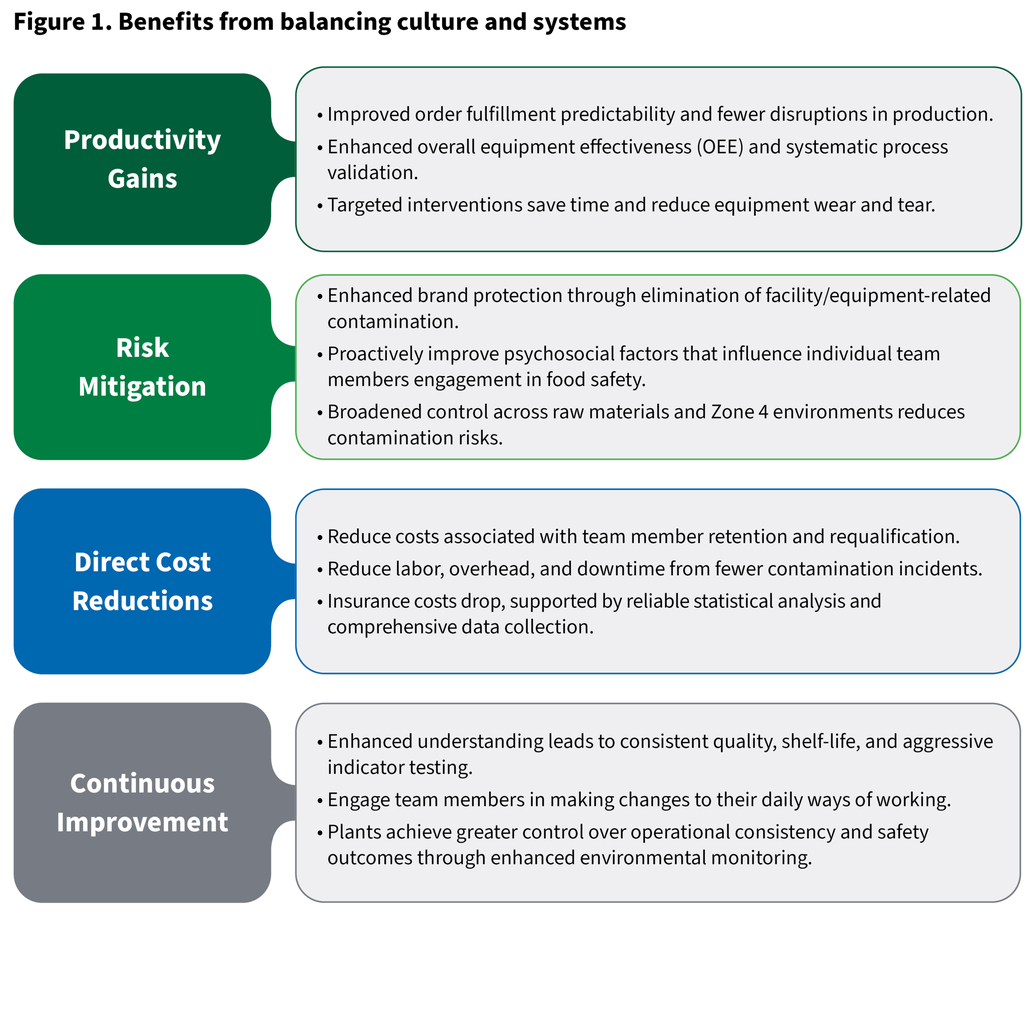
Figure credit: (Neogen, 2025)
Complex supply chains, evolving regulations, and rising consumer expectations add significant pressure to an organization. Suppliers and producers around the world operate within different economic realities, regulatory systems, and cultures. Even if an organization has a strong internal food safety culture, extending that influence across borders takes a deeper understanding of local behaviors and expectations. National culture values are often much harder to shift than organizational ones including perception of risk (Taylor, 2011) . When people feel that food safety risks are low, hygiene and handling behaviors tend to slip (Nyarugwe et al., 2020). Trainers working across diverse markets could find that what happens in the training room may not stick once employees return to their workplaces or their surrounding cultural norms (Taylor, 2011). Legislation and public enforcement can also shape food safety behaviors (Nyarugwe et al., 2020). In countries where regulations are less developed, sometimes due to limited funding or infrastructure, private standards and certification programs can help fill the gap and support behavioral change (Nyarugwe et al., 2020).
While organizational consensus to embed food safety culture is positive, trying to systemize food safety culture and tracking as a performance metric could potentially set an organization back. This approach puts food safety culture at risk of being an obligation rather than a long term, multi-faceted evolution (da Cunha, Stedefeldt, Luning, Prates, & Zanin, 2025) . Indeed, as stated by GFSI in 2018, “culture exists independently of written rules, not just as a consequence of following rules…” (GFSI, 2023) . Culture is built through daily interactions, leadership behaviors, shared values, and continuous learning.
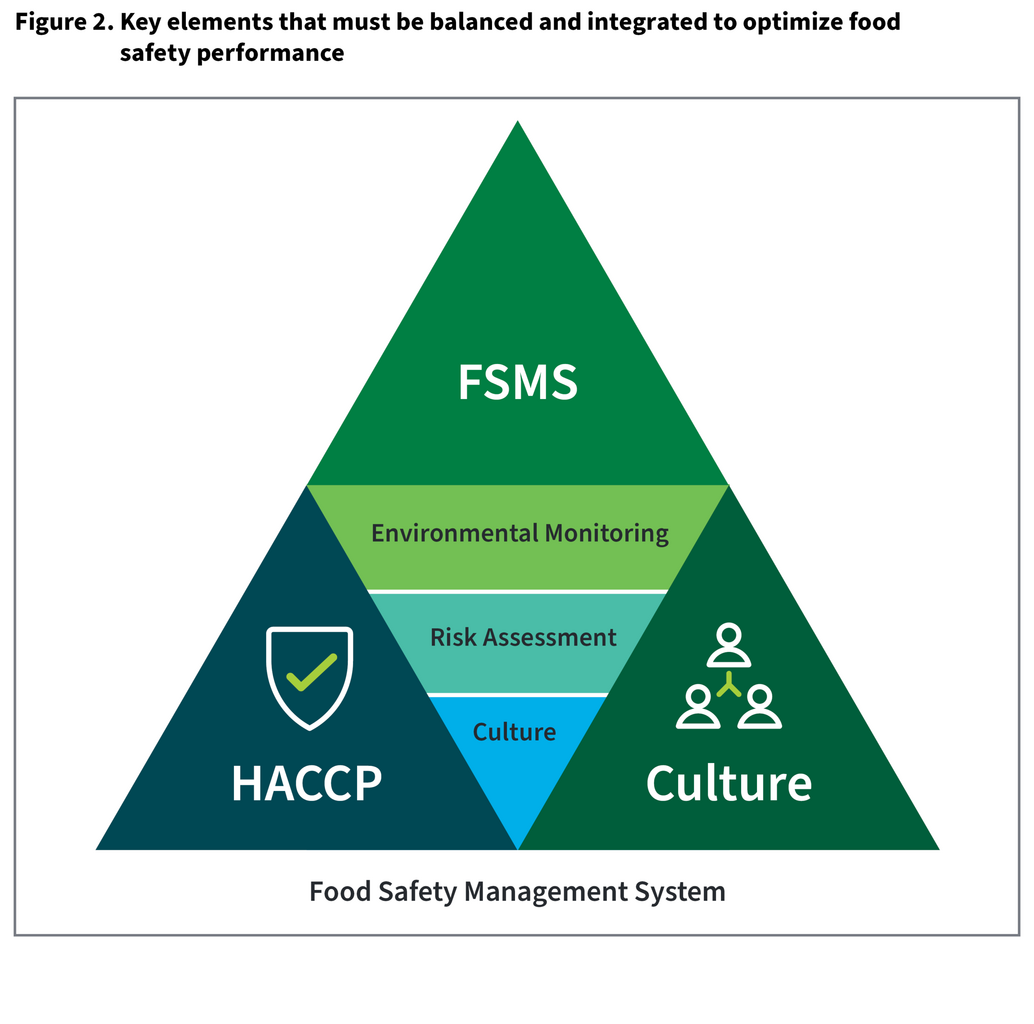
Figure credit: (Neogen, 2025)
The capacity and desire to change the culture of an organization is a dynamic process. Rather than feeling stuck or frustrated that the path to a more proactive food safety culture is not linear, it is better to appreciate the dynamics of the process. Understanding of the internal (e.g. change in management) and external factors (e.g. regulations, culture) can help move organizations forward in their food safety culture journey. There will be setbacks and motivators to move between compliance and proactivity. Understanding these forces helps organizations stay adaptable and continue making progress, even when the path isn’t perfect. What matters most is the commitment to keep going.
Neogen is a proud supporter of the Global Food Safety Initiative. We look forward to meeting attendees at our booth and hosting an engaging discussion on this topic during our 2026 GFSI Conference special session, “Quality and Safety are More than Just Boxes to Check“ on Wednesday, March 25th at 1:45 PM.
Visit info.neogen.com/EMPresource to learn more on balancing culture and FSMS in relation to environmental monitoring.
References
da Cunha, D. T., Stedefeldt, E., Luning, P. A., Prates, C. B., & Zanin, L. M. (2025). Food safety culture as a behavioural phenomenon shaping food safety. Current Opinion in Food Science.
GFSI. (2023). GFSI: A culture of food safety. A Position Paper from the Global Food Safety Initiative (GFSI).
Griffith, C., Livesey, K., & Clayton, D. (2010). Food safety culture: the evolution of an emerging risk factor? British Food Journal, 426-438.
Hogg, M., & Vaughan, G. (1995). Social Psychology (2nd ed.). Glasgow: Prentice-Hall.
Neogen. (2025). Environmental Monitoring Handbook for the Food and Beverage Industries (2nd ed.).
Nyarugwe, S. P., Linnemann, A. R., Ren, Y., Bakker, E.-J., Kussaga, J. B., Watson, D., . . . Luning, P. A. (2020). An intercontinental analysis of food safety culture in view of food safety governance and national values. Food Control.
Sharman, N., Wallace, C., & Jespersen, L. (2020). Terminology and the understanding of culture, climate, and behavioural change — impact of organisational and human factors on food safety management. Trends Food Science Technology, 96:13-20.
Taylor, J. (2011). An exploration of food safety culture in a multi-cultural environment: next steps? Worldwide Hospitality and Tourism, 455-466.